Intellectual property law provides multiple tools to protect the look of products. Two of the most important are design patents and trademarks. While both can protect visual aspects of products, they operate differently and serve distinct strategic purposes. Many successful companies use both forms of protection to safeguard design and brand identity of a single product.
What Is a Design Patent?
A design patent protects the ornamental appearance of a product rather than how the product works (which is covered by utility patents). In the United States, a design patent may be granted to anyone who invents a new, original, and ornamental design for an article of manufacture. Design patents cover visual features such as the shape or configuration of a product, surface ornamentation or decorative patterns, or a combination of shape and ornamentation. For example, jewelry designs, furniture shapes, and beverage containers may qualify for design patent protection.
To obtain a design patent in the United States, the design must meet several requirements. First, the design must be novel in that the design must be new and not previously disclosed to the public. Second, the design must be original. This means that the inventor originated the design rather than merely copying an existing design. Third, the design must be non-obvious: the design cannot be an obvious variation of prior designs to an ordinary designer. Finally, the design must be ornamental in that it is primarily aesthetic rather than purely functional.
A key element of a design patent is the drawings. Unlike utility patents in which the scope of protection is defined by written claims, in design patents the drawings define the scope of the claim. Specifically, features shown in solid lines are protected, while those shown in broken lines are not.
Design patents give the patent holder the right to prevent others from making, using, selling, or importing products with a substantially similar appearance. Even if the product is not identical, infringement can occur if the overall visual impression is similar. This makes design patents a powerful tool against copycat products that mimic a distinctive design.
Design patents offer several advantages but have some limitations. Design patents offer strong exclusive rights against substantially similar designs, a clear scope of protection defined by patent drawings, and are relatively fast and inexpensive compared with utility patents. Design patents are also useful for protecting distinctive product shapes early in a product’s life cycle. However, design patents also have a limited duration (15 years from issuance in the United States). There is no way to renew a design patent once it expires, and the protection applies only to the specific appearance claimed in the drawings.
What Is a Trademark?
A trademark protects symbols or features that identify the source of goods or services. Common examples include brand names, logos, slogans, sounds, and colors. Part of trademark protection is trade dress, which extends trademark protection to the visual appearance of a product or its packaging, such as shape, color combinations, or overall design. In some instances, trade dress protection can overlap with design patent protection.
To obtain trademark/trade dress protection, several requirements must be satisfied. First, the mark/design must be distinctive in that it must identify the source of the product. Second, the mark/design must not be functional. Third, the mark/design must be distinguishable from other marks used for similar goods so as not to cause a likelihood of confusion. For product designs, courts usually require proof of secondary meaning – that consumers recognize the design as identifying a particular brand.
Trademark law protects features that indicate the origin of goods. This may include brand names, logos, symbols, packaging design, and product shapes that identify a brand. Unlike patents, trademark rights are focused on preventing consumer confusion about who produced a product.
The advantages and disadvantages of trademark protection are different than patent protection. Trademarks require use to be registered and offer potentially indefinite duration so long as the mark remains in use. Trademarks can be powerful protection of brand identity and can increase brand recognition and marketing value. Trademarks are often used to stop confusingly similar designs or packaging. Despite these benefits, trademarks also have some drawbacks. Specifically, functional product features cannot be protected under trademark law. In addition, product designs often require proof of secondary meaning, which can take years to develop. Finally, enforcement often requires a demonstration of consumer confusion.
When are Both Appropriate?
Design patents and trademarks are not mutually exclusive. In fact, they often work together as complementary tools. Design patents can be used to protect the initial product design, while trademarks protect the brand recognition that develops over time. This combination provides layered protection for innovative products. For example, one could file a design patent to secure patent protection for the product’s appearance, then build brand recognition through marketing and consumer exposure. This would allow one to seek trademark or trade dress protection once the design becomes associated with the brand. This approach allows companies to maintain protection even after the design patent expires.
This strategy was used by Coca-Cola® for the unique shape of their bottle. In 1915, Coca-Cola® obtained a design patent covering the ornamental bottle shape. The design patent figure is shown below.
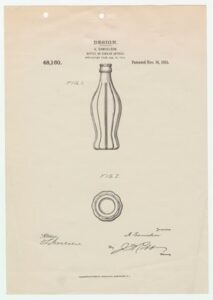
While that patent eventually expired, over time consumers came to strongly associate the bottle shape with the Coca-Cola® brand. As a result, the bottle’s shape later became protected as trade dress under trademark law, allowing Coca-Cola® to continue preventing competitors from using confusingly similar bottle designs. Some of Coca-Cola’s® registrations are shown below:
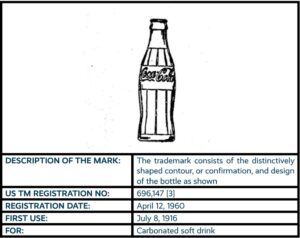
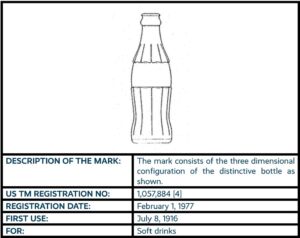
The Coca-Cola® bottle demonstrates how this strategy can create lasting brand protection, transforming a simple product shape into one of the most recognizable icons in the world. Filing a design patent early helps prevent copycat products, while developing trademark protection ensures that a successful design remains linked to the brand long after patent rights expire. This layered strategy ensured long-term protection: the design patent provided early exclusivity, while trademark protection preserved the brand identity indefinitely. Businesses that rely on distinctive product designs – especially consumer goods companies – often benefit from using both forms of protection.
Developing a Strategic Approach to Product Design Protection
Companies developing distinctive products should consider how design patents and trademarks can work together to protect both the appearance of their products and the brand recognition that develops over time. A thoughtful intellectual property strategy can help preserve these advantages as products grow in the marketplace. Contact Conley Rose to discuss how your organization can develop a product design protection strategy that aligns with your long-term business goals.